Building the pipeline
A sales-driven process for hiring


In the previous article, I argued that recruiting is just a sales process. And like any good sales process, it starts with a great product: an exceptional place to work. Now it’s time to hit the streets and start selling.
To do so, let's first understand how a sales process works:
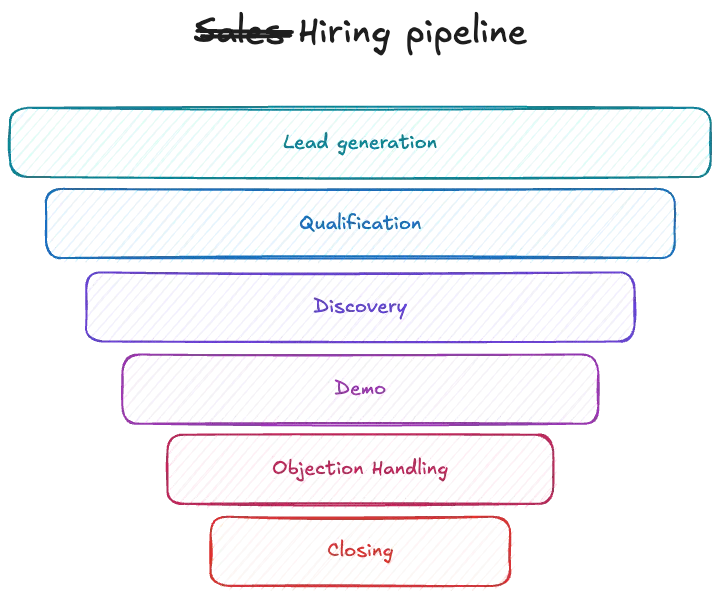
Lead generation: Identify your ICP (Ideal Candidate Profile) and start collecting leads.
Qualification: Qualify the leads by checking if they match your ICP.
Discovery: Understand their needs and pain points.
Demo: Show them your product and how it can solve their problems.
Objection Handling: Address concerns.
Closing: Close the deal.
Most sales processes follow a similar flow, and hiring works much the same way. The key difference is that Objection Handling in hiring cuts both ways: you’re also assessing whether the candidate is a good fit. You don’t often hear a salesperson say, “Sorry, we don’t think you’d make a good customer.”
I’ll explain how to handle each of these stages. But beware, what follows is very opinionated. If it wasn’t, you wouldn’t need to read this article, just ask ChatGPT.
Lead generation
This is the most painful step of the hiring process. It's soul-crushing work, but it's the only way I know to grow your team.
There are several ways to generate leads, each with its pros and cons. You’ll start with outbound, but as you grow, you’ll be do more inbound and referral channels.
Lead generation: Outbound
Outbound means proactively reaching out to people. This is the first channel you have to master since, at the beginning, no one knows who you are. Posting jobs will only get you bots or low-quality candidates, so get good at finding and contacting people yourself.

Your main tools will be LinkedIn, GitHub, and Twitter/Bluesky. You need to develop good heuristics to identify the right candidates efficiently.
Spend a couple of hours every day sourcing candidates. You should find at least 5 per hour, so that's around 50 per week. With time, you’ll discover ways to improve that number.
Some tips are:
Use advanced search filters on GitHub. Be creative.
Find companies with your stack on LinkedIn and located in your target market. Each company has a list of employees, so you can reach out to them. This is called poaching, and you have to do it delicately. The ecosystem will resent you if you raid a company going through a tough time. And the ecosystem matter, the more benevolent you are seen, the easier things will get in the future. So, allow yourself to be slightly evil, but never an asshole.
Use Twitter/Bluesky search to find candidates discussing topics or tools relevant to you.
Go to conferences and meetups and collect people’s contact information.
Discord? A great dev.to article? A Hacker News post? Reddit threads? There are candidates everywhere. I even contact people writing code on their laptops at local cafés.
The ultimate outbound tip: look in unexpected places. Everyone targets the same talent pool: engineers from startups or big tech. There’s no alpha there. If you stay creative and open-minded, you’ll find hidden gems for a fraction of the cost. Some of the best engineers I’ve met were underrated and underpaid.
If you’re remote, explore countries with a lower cost of living but strong developer communities. If not, look at agencies or game studios that work under tough deadlines for much less than cushy startups pay.
It’s essential to use some kind of CRM to track all your leads and the companies you’re sourcing from. You can use an ATS (Applicant Tracking System), a simple spreadsheet or a no-code tool. I did most of my recruiting with Airtable, and it worked fine.
Some information you want to collect at this stage is:
Name: Real or nickname, mostly to personalize the message.
Email: Often available on GitHub; there are tools to extract them automatically but don’t spam anyone. A respectful email works far better than a LinkedIn message.
Positions: Which roles they might fit.
Created at: How long they’ve been active on your CRM.
Company: Where they currently work.
Why: Why you liked this candidate and why they might be a good fit. That’s a very important field, since you will likely separate sourcing from contacting, and you will need this information on the cold email.
Current job start date: Avoid contacting people who recently changed jobs (2+ years is a perfect threshold), but keep them on file for later.
Stage: Start with “lead” and later move them to different stages.
Source: For now, “outbound.” Later, you’ll identify which channels work best.
Assigned to: Probably yourself, but as you grow, ensure each candidate speaks to only one person from your company.
Persist this data. You’ll need it to understand what works and what doesn’t. While I don’t advocate for purely data-driven hiring (too high variance), having a reality check is always helpful. Also, as you scale, more people will join the process, and candidates will pass through multiple hands.
Lead generation: Referrals
The second most important channel is referrals. It’s low-volume but extremely efficient. You already know more about the candidate, and convincing them is much easier.
There’s always debate about whether referrals should be incentivized. On one hand, people take social risk when convincing friends to join. The better your company is, the lower that risk and people who love their job will naturally tell their friends about it. On the other hand, you don’t want to encourage people to bring in unfit candidates just for the money.
What worked for me was mild compensation. It’s a “thank you,” not a financial incentive. Enough to show appreciation, but not enough to motivate people extrinsically.
Lead generation: Inbound
Inbound is what most companies overspend on: job posts, ads, and hope. It’s inefficient, especially early on. Without brand recognition, the only thing you can do to attract candidates with Inbound is to throw money at it: buy job postings and hope for the best. Even then, you won't get the talent you want, just flood your pipeline with low quality candidates that will take away your precious time.
Use that time to do Outbound instead.
Still, having job posts on your site is useful. When you reach out to candidates, they’ll check your website and browse openings. Sometimes you’ll get lucky. Maybe someone heard you on a podcast or read an article and reaches out. Just don’t rely on it as your main hiring channel.
Lead generation: Recruiters
This is where I piss off a whole industry and burn some bridges.

Don’t use external recruiters,
If you do, hire them,
mostly one.
Companies spend absurd amounts on external recruiters, often 10–25% of a candidate’s salary. Their incentives are rarely aligned with yours.
That said, you might eventually need recruiters: seasonal peaks, pivots, or roles you’ve never hired before. Just don’t rely on them too much. They’re like drugs and paid advertising: magic at first, but hard to party without them on the long run.
If you do want to use recruiters, start with several in parallel (they’ll ask for exclusivity; negotiate that). Later, hire the one who performs best. One is enough. And they should report to you, not HR. Otherwise, you’ll have someone whose performance is judged by another department, and that’s a recipe for disaster.
In my opinion, recruiters should only handle outbound sourcing. Some companies let them do first contacts or screenings, but that’s a mistake. The first call is crucial and should be done by a technical person. Engineers prefer speaking to peers, not recruiters who confuse Java with JavaScript. Screening is delicate, and we’ll discuss it later. Always have a technical person do it.
Qualification
Great, you now have leads and are ready to qualify them.
This process differs slightly depending on the channel – let's delve into it (not written by an LLM, I'm just teasing you).
Qualification: Outbound
You’ve spent a week sourcing and now have 50 leads. Time to reach out. If possible, contact them via email. If not, try Twitter/Bluesky DMs, then LinkedIn. From most personal to most professional.
Craft a banger message. The title should be direct, and the body should feel personal and unique for each candidate.

My go-to structure:
Title: Simple, human, and direct. If you have a good title (CTO, VP of Engineering), show it off. Let them know you’re not a recruiter. What works best for me is something like:
“Hi, I’m the [your title] of [company name], and I want you to join us.”
Body
Who you are and what the company does: A brief, clear intro and a pitch that works.
Why you’re reaching out: Be genuine and flattering. Mention what caught your eye, their OSS project, experience, or work you admire. This is a personalized message and hopefully you had it saved on your CRM.
Why you’re hiring: Explain why the role exists and its expected impact.
Your product: Describe what working at your company feels like. If you sourced right, it will resonate.
Link to your calendar: Invite them to chat. Make it sound casual, not like an interview.
Link to your Employee Handbook: The mic drop. This document explains everything they need to know about working with you. Candidates who say “hell yeah” will save you time, and those who decline save even more.
Writing well is important. You have 2 seconds to grab their attention, so you better get better at this. I recommend newsletters like marketing examples to get better at copy. A good message can get around a 15% response rate. From 50 sourced candidates, that’s about seven qualified leads per week, not bad!
Qualification: Inbound & Referrals
Less exciting but necessary. Define your criteria and process, then go through your ATS or CRM. Discard those who clearly don’t fit, and send the rest a calendar link.
If someone isn’t right for a current role but could fit later, keep them. Build a future pipeline.
Discovery & Demo
I like to bundle discovery and demo into a single step: the first interview.
First rule: don’t call it an interview. It’s a chat. If you’re meeting in person, have a coffee or beer, but not in the office.

This keeps it personal, not transactional. You want the candidate to open up.
The goal is twofold:
Understand who they are and what they want in life.
Show them how your company fits that vision.
That order matters.
Gather information first to personalize your pitch. Are they aiming to be a CTO in five years? Great. Show them that path.
Make them comfortable. For instance, I try to make candidates laugh in the first two minutes. Be clumsy, be human. Like Dr. Slump’s Senbei Norimaki, you can get serious later.
Ask open ended questions and let them do the talk. When they open a box, dig deeper. When they don't, try mirroring (repeat what they last said).
Me: So, how is work nowadays?
Candidate: It's ok. <crickets, he is not going to expand... time to mirror>
Me: It's ok?
Candidate: Yeah. Good salary, and the manager is ok.
Me: What do you mean the manager is ok?
Candidate: You know, I had non-technical managers who just asked “how’s the project going?” I want someone technical who can help me grow.
Me: Yeah, I've seen that too. How does he help you grow? What does grow even mean?
This is great, now we are getting to an interesting place and the candidate is feeling more comfortable and willing to share. Mirroring works wonders.

For getting information out of interviews I highly recommend reading Never split the difference by Chris Voss. Yes, I know. The book is about negotiation with terrorists, but the principles are similar: building trust so the conversation can lead to a positive outcome for both parties.
You can also sprinkle the conversation with some open ended questions that help complete the picture. Remember: you are not evaluating, you are discovering who you have in front of you. Experiment and write down what questions that work best for you.
Here are some that I’ve used in the past:
What's something you don't want to do?
If you could write your perfect job description, what would it be?
What makes you happy, angry, or sad?
What rabbit holes have you chased recently? Why?
If you didn’t have to work anymore, what would you do?
The second part of the chat flips the roles: you talk, they listen. Be charming, be honest, and remember that not everyone will like you, and that’s fine. It’s a numbers game.
The goal is for them to leave thinking, “Hell yeah, I want to join tomorrow.” Most companies get this backward. They drag candidates through hoops, then try to excite them at the end. You must excite them early because candidates never do your process alone.
Once someone starts interviewing with you, they’re also interviewing elsewhere. If you win their excitement and move fast, you’ll likely win them and shorten the time to hire. That's the main difference between buying and selling.
During this second half of the interview I recommend you to cover the following points:
Why the company exist
The product and the market
The company’s story and your background
Your financial situation. Be honest. This matters to a lot of engineers. Are you profitable? Say it loud, they will love that. Did you just raise a round? Mention it. Are you running out of money? I'm sorry about it, but also mention it. They will figure out sooner or later, and you would rather have them not join than leave in 1 week and waste your precious recruiting efforts.
The team
The culture
Review together the Employee Handbook so there are no questions or surprises. Talk about the employee lifecycle, the company cadence and whatnot.
If done correctly, the only thing left is for you to discover whether you want to work with them or not (buying). This means that salary is agreed at this point, not after the last interview. This is very important. There is nothing worse than spending countless hours to lose the candidate on the last step. And is not fair for the candidate either. Don't delay it. If you don’t like talking about money, rip it off. After all, you already know the price tag.

If the candidate is stronger or weaker than expected, adjust by offering a higher or lower position, not by haggling salary. People hate salary negotiation but are fine negotiating roles.
Wrap up by thanking them and asking if they’d like to start the process (remember, this was not an interview). If you’ve done well, they’ll say, “Let’s fucking go.” Then schedule the technical interview.
If your company is genuinely appealing, you should convert around 80% of these. From 7 qualified leads, you’ll get 5 interviews. If not, improve your pitch.
Objection handling
Now comes what you’re probably already doing: interviewing candidates. It’s time to figure out whether this person is really a good fit for the position or not.
My advice is to keep it simple and short. That’s it. The rest is fluff.
In my experience, and other companies confirm this, each interview has diminishing returns. During the first one, you get most of the information you need; in the following ones, not so much. Every extra interview decreases your chances of closing the candidate. Remember, you are competing against other companies, and whoever lands an offer first has an edge.
False positives and negatives are inevitable, no matter how much you interview. If you believe that talent follows a fat-tailed distribution (I do), your strategy should be to minimize false negatives. The ones who get away. Passing on a future Jeff Dean is worse than hiring someone who doesn’t work out. Your team, like most investment portfolios, will end up following a Pareto distribution. A very small set of engineers will be responsible for the majority of the company's success.
This doesn’t mean you should only hire staff+ engineers and ignore everyone else. It means you should evaluate candidates not for what they know but for what they can learn. Knowledge is easy, and getting easier by the day. But creative, curious minds are scarce.
Unfortunately, most interviews still test knowledge. Candidates can easily master the interview process, the same way LLMs cheat by engulfing all benchmark data.
What are you really testing by having a candidate solve an algorithm or data structure problem? That they’ve practiced “Mastering the Job Interview”? It’s as absurd as IQ testing, which mostly predicts how good someone is at taking IQ tests.

The best interviews are conversational. They’re hard to fake, and if you ask the right questions, you’ll learn everything you need to learn in just one interview. If you don’t believe me, listen to how Tyler Cowen interviews people, and notice how they crumble under intellectual pressure.
In these conversations, you can see how candidates reason, linearize complex thoughts, and connect or create ideas in real time. Tease them with humor. I’ve never seen an LLM make me laugh, and humor is a better proxy for intelligence than logic puzzles.
When you’re in front of a brilliant mind, it’s a fantastic experience. But it’s not quantifiable: it’s an “I know it when I see it” kind of thing. There’s no scorecard for a great conversation, and your gut will be right about 90% of the time. That’s a fantastic error rate you won’t improve no matter how many tests you make the candidate endure.
How is that interview structured? It's just talking? Isn't this "too easy"? Hold your horses! First of all, difficulty doesn’t lower error rates; it just builds exclusivity theater. And no, it's not just talking: You ask the candidate to bring code they've wrote. It can be an open source, a side project, or a take-home exercise they wrote for another company. At some point, I got to know most companies’ homework assignments in Barcelona. They weren’t very good.
Candidates love this approach. As I mentioned earlier, they’re usually interviewing with several companies, trying to maximize their chances of success. Skipping the take-home exercise is a massive speed-bump for both sides.
Assemble a team of 2 or 3 engineers to interview the candidate (yourself included if you are part of this hiring process). Usually 2 senior+ and 1 junior/mid that is mostly shadowing and learning how to interview. Spend 1 to 2 hours with each candidate. For manager roles or staff+ positions you might want to have a second interview to touch on different topics with more depth.
If the code they bring is not that interesting, then just ask open ended questions. Those shouldn't have a correct answer, like most things in life. They need to be juicy and have different levels of depth, like most things in life(2).
Some questions that I've used in the past:
Role play. the CEO storms in, stressed because customers are complaining the app is down. What do you do? Whatever they say, dig deeper. If it’s a senior role, the root cause should be something gnarly: Postgres wraparound IDs, a rogue Bitcoin miner, or maybe a solar flare flipping a bit.
You’re hired, and your first task is to add search. What do you do? This opens discussions about databases, synchronization, change data capture, and search algorithms.
How would you architect a real-time game? Why is it different from a traditional SPA? This explores distributed systems and state synchronization.
Tell me about a time where you made a technical decision that had a meaningful business impact. Oh boy, do they trip over this one.
Tell me of your biggest fuckup. What did you learn from it?
That’s it. You have a conversation, review the code, and follow your instinct. If you feel good about the candidate, make an offer.
The % of people that pass this process will largely depend on your risk aversion and how well have you sourced and done the first interview. You’ll usually see 20–50% of candidates pass. Lower than that means too strict; higher means too lenient. But take those numbers with a grain of salt. The sample sizes are small, and you’ll have lucky and unlucky streaks.
From the previous 5 candidates, this should leave you around 2 candidates to make an offer to. Getting there! Are you excited? Let's go!
Closing
The final step is to make an offer. You need a badass template ready with all the details and a deadline. A deadline? Don’t engineers hate deadlines?
Yes, they do. But job offers without deadlines suck for everyone. Here’s how things usually go wrong: you send an offer, freeze the position because you don’t want to be an asshole, and the candidate goes silent. One week passes, then two, then three. Suddenly, they tell you they’ve accepted another offer from a slower process than yours.
Bummer.
You’re now three weeks behind schedule. Sure, you could keep interviewing candidates instead of freezing the position, but that’s even worse for the candidate, who might have already told their current employer they’re leaving.
The solution is simple: set a deadline and be transparent about it. Tell them, “I’ll freeze this position for you for one week. After that, I’ll continue hiring for it.”
It’s fair for both parties. Everyone has time to think and decide, and the consequences are clear.
More importantly, a deadline creates urgency, and urgency triggers emotion. If you’ve done the first interview well, the candidate will be excited enough to overcome the fear of leaving their safe job or finishing other interview processes.
Track how long it takes from first contact to offer. Your close rate is inversely proportional to your time to hire. A realistic, excellent time to offer is two weeks.
The offer stage should have one of the highest close rates in the entire process since all details have already been discussed and agreed on. At this point, it’s just a final decision. A good close rate is around 80–90%.
That means from your last two candidates, at least one will accept.


Comments
No comments yet. Be the first to comment!